
Digital Burnout Symptoms: 15 Warning Signs You're Mentally Exhausted from Screens
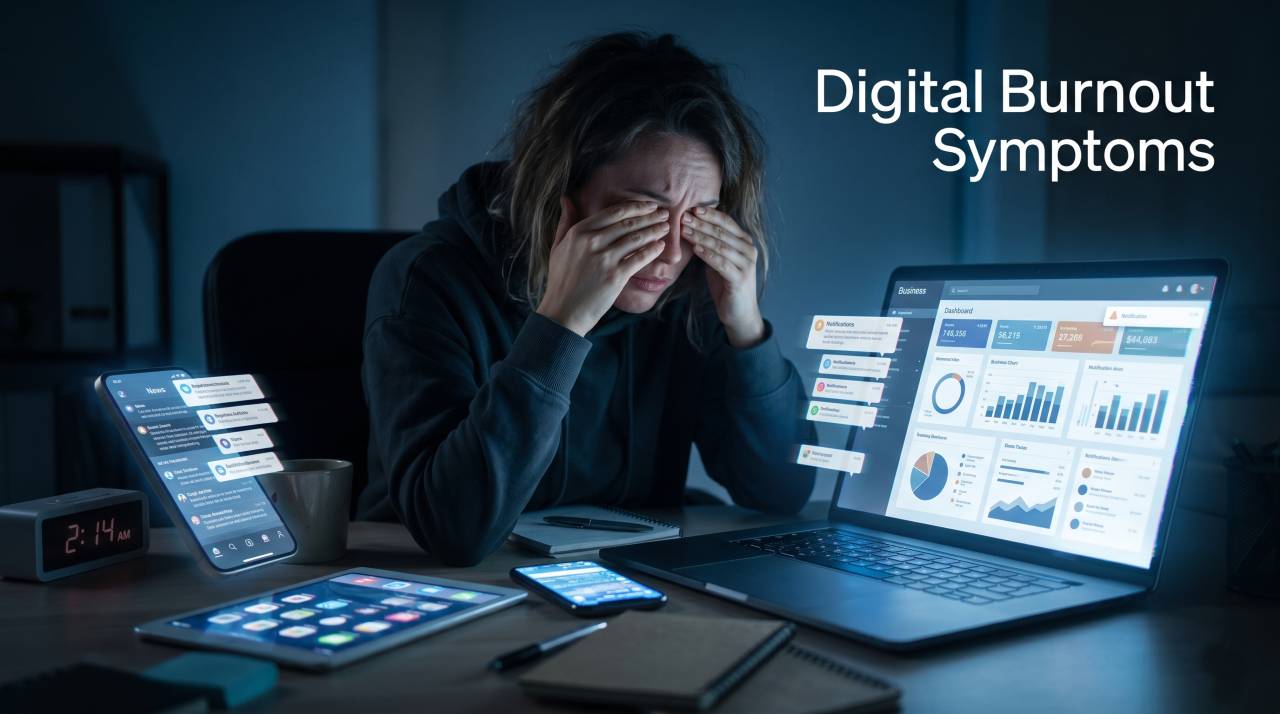
You open your laptop and already feel exhausted
You check Slack before you've had your first coffee. By noon your eyes feel like sandpaper. By evening you're staring at Netflix but not really watching anything, just... there.
If that sounds familiar, you might be dealing with digital burnout symptoms, and you're not alone in it. Millions of people, especially remote workers and anyone spending long hours online, are hitting a wall they never saw coming.
According to the 2025 Microsoft Work Trend Index, the average person using Microsoft 365 gets interrupted by a meeting, email, or notification every two minutes during the workday. On top of that, screen time has climbed to an average of 11 hours a day for adults in digitally connected countries. That's most of your waking life.
So let's get into what's actually going on, how it's different from ordinary burnout, and what actually helps.
What Is Digital Burnout?
Digital burnout isn't just being tired after a long day on your computer. It goes deeper than that.
Researchers use the term technostress for the underlying strain: the toll that constant digital demands, interruptions, and blurred work-life boundaries take on your nervous system. Digital burnout is what happens when that strain piles up over time and never gets a chance to reset.
Here's the difference: normal tiredness clears up after a good night's sleep. Digital burnout doesn't. It builds slowly, over weeks or months, through nonstop screen time, endless notifications, back-to-back video calls, and never truly logging off.
It's a specific kind of mental exhaustion that comes from being permanently "on." Always connected. Always reachable. Always scrolling.
Regular stress usually passes once the stressor is gone. Digital burnout is different. It chips away at your ability to concentrate, enjoy things, or even care. It feels less like being tired and more like a phone battery that's stuck at 1% no matter how long you charge it.
And it sneaks up on you. Most people don't clock it until they're already deep in it.
Digital Burnout by the Numbers
If you've been wondering whether this is just you, it isn't. A few things worth knowing:
- Global employee engagement and wellbeing have been sliding for years, according to Gallup's State of the Global Workplace report, with stress levels still sitting above pre-pandemic norms.
- People at companies leaning hardest into always-on digital tools report getting interrupted roughly every two minutes during the workday, per Microsoft's Work Trend Index research.
- Computer Vision Syndrome, the eye strain and headaches tied to screen overuse, is estimated by optometry researchers to affect somewhere between 50 and 90 percent of regular screen users.
- Stanford researchers have studied the real cognitive toll of video calls, sometimes called Zoom fatigue, and traced it back to the amount of close-up eye contact and nonstop self-viewing (staring at your own face) that video platforms force on people.
- The World Health Organization classifies burnout as an "occupational phenomenon" caused by chronic, unmanaged workplace stress, not as a medical condition in its own right. More on that distinction below.
None of this is in your head. The numbers back up what your body's already telling you.
Digital Burnout vs. Work Burnout vs. Anxiety and Depression
People mix these up constantly, so it helps to separate them out.
Work burnout, the kind the World Health Organization officially recognizes, usually comes from job-specific issues: an unmanageable workload, no sense of control, a toxic environment. It's tied to a role.
Digital burnout is both narrower and broader. It's triggered specifically by screen overuse and constant connectivity, but it isn't limited to your job. It can come from social media, gaming, parenting apps, or just general nonstop device use. You don't need a demanding career to develop it.
Anxiety and depression are clinical conditions with their own diagnostic criteria. Burnout, digital or otherwise, isn't a formal mental health diagnosis on its own, but it can overlap with or lead into anxiety and depressive symptoms if it goes unaddressed. That's why ongoing symptoms deserve real attention from a professional rather than a guess on your part.
These three often show up together, especially for remote workers, but not always as a package deal. Knowing which one you're actually facing changes what kind of help will actually work.
Quick Self-Check: Rate Your Symptoms
This isn't a clinical test, just a way to get a clearer read on where you're at. For each symptom, think about how often it's applied to you over the last two weeks.
| Symptom | Rarely | Sometimes | Often/Constantly |
|---|---|---|---|
| Dread opening your laptop or inbox | |||
| Eye strain, headaches, or blurry vision | |||
| Can't focus for more than a few minutes | |||
| Irritable over small things | |||
| Disrupted or restless sleep | |||
| Tired but wired, can't relax | |||
| Social media feels overwhelming, not enjoyable | |||
| Lost interest in hobbies or people | |||
| Dread video calls | |||
| Mindless scrolling that leaves you feeling worse | |||
| Forgetfulness or brain fog | |||
| Physical tension in neck, shoulders, or back | |||
| Can't switch off after work hours | |||
| Feel present but mentally checked out | |||
| A screen-free day sounds anxiety-inducing |
Mostly "Rarely": You're managing okay, but keep an eye on your habits before they drift. Mostly "Sometimes": This looks like early-stage digital burnout. This is the best time to make changes, before it compounds. Mostly "Often/Constantly": This has probably been building for a while. Try the recovery steps below, and consider talking to a professional if it's been going on for weeks.
15 Warning Signs of Digital Burnout
1. You Dread Opening Your Laptop
Remember when you actually liked your work? Now even looking at your laptop feels heavy.
It's not laziness. It's your brain telling you it's overloaded. When the thought of opening your inbox triggers a low-level sense of dread, that's worth paying attention to, not brushing off.
If Sunday evenings now come with a quiet anxiety about Monday morning, take that seriously.
2. Your Eyes Hurt, Constantly
Dry eyes, blurry vision, headaches sitting right behind your forehead. Classic screen fatigue.
If you're staring at screens for 8 to 10+ hours a day, and most remote workers are, your eyes are working overtime without a real break. The pain is real, and it doesn't just go away overnight.
Optometrists call this Computer Vision Syndrome, and it's driven by a lower blink rate, bad screen positioning, and glare, not just "too much screen time" in the abstract sense. The 20-20-20 rule (every 20 minutes, look at something 20 feet away for 20 seconds) genuinely helps, but only if you actually remember to do it.
3. You Can't Focus on Anything for More Than a Few Minutes
You sit down to write one email. Twenty minutes later, you've checked Instagram, opened YouTube, and forgotten what you were even doing.
This scattered, restless inability to concentrate is one of the most common digital burnout symptoms. Your attention span has basically been trained to fragment, by notifications, by multitasking, by the constant pull of the feed.
It's not a character flaw. It's what happens when your brain gets rewired by too much stimulation.
4. You Feel Irritable for No Obvious Reason
Someone sends a simple question on WhatsApp and you feel a flash of annoyance. Your partner says something completely normal and it gets under your skin anyway.
Digital overload messes with your emotional regulation. When your nervous system stays overstimulated all day, small things start to feel huge. It's rarely really about the message. It's about the state you were already in when it arrived.
5. Sleep Is a Complete Mess
You're exhausted all day. Then 11pm rolls around and your brain refuses to shut up.
Screen exposure, especially in the evening, suppresses melatonin. Add in the leftover mental noise from work pressure and social scrolling, and you end up lying awake at 1am replaying a conversation from six hours earlier.
Bad sleep then makes everything worse the next day. It's a cycle that feeds itself.
6. You're Physically Tired But Still Wired
This one is confusing and genuinely uncomfortable. You feel completely drained, but somehow still restless, tense, or anxious.
That "tired but wired" feeling is your nervous system stuck in overdrive. It's a classic sign of burnout from screens mixed with prolonged remote work stress. Your body wants to rest, but your brain hasn't gotten the message yet.
7. Everything Online Feels Overwhelming
You open Instagram and instead of enjoying it, you feel crushed. Overwhelmed. Vaguely bad about yourself.
Social media used to be fun. Now it's just noise. When platforms you used to enjoy start feeling like a chore or a source of low-grade anxiety, your brain is telling you it's done processing input for a while.
This is social media overload, and it does exactly what the research says it does: raises cortisol and lowers your sense of wellbeing.
8. You've Lost Interest in Things You Used to Love
Not just work stuff. Everything.
The hobby you loved? Can't be bothered. The show you were obsessed with? Can't focus on it. The friend you keep meaning to call? Too tired to follow through.
This kind of emotional flatness, sometimes called anhedonia, shows up when mental exhaustion goes untreated for too long. It's one of the more serious signs that your tank is genuinely empty.
9. Video Calls Make You Want to Disappear
Zoom fatigue is real, and Stanford researchers have documented why: the unusual amount of close-up eye contact, constant self-viewing, and reduced mobility that video calls force on you. None of that happens in a normal in-person conversation.
If you feel a wave of dread before every video call, or feel completely wiped out after an hour of meetings, your brain is paying a real price for that digital performance.
10. You Mindlessly Scroll Without Enjoying It
You pick up your phone because you're bored. You scroll for 30 minutes. You put it down feeling worse than before.
This loop, boredom, phone, hollow consumption, feel bad, repeat, is a hallmark of digital burnout. You're not getting anything from the scrolling. You're just numbing out.
The fact that it keeps happening even though you know better is what makes it so draining.
11. You're Forgetting Things More Than Usual
Walk into a room and forget why. Open a tab and have no idea what you were even searching for. Blank on the name of someone you've known for years.
Chronic mental exhaustion impairs working memory and recall. Your brain is so busy managing overstimulation that it doesn't have bandwidth left for the normal stuff.
12. Your Body Feels Awful
Tight neck. Aching shoulders. Lower back pain. Tension headaches that seem to live permanently above your eyes.
Digital burnout isn't just mental, it lives in your body too. Hours hunched over screens build up physical tension that piles on top of the mental exhaustion, making everything feel heavier than it should.
13. You Can't "Switch Off" After Work Hours
It's 8pm. You've closed the laptop. But work is still running in the background of your brain.
You're mentally drafting emails. Replaying that meeting. Worrying about tomorrow's deadline. Without a physical commute, there's no built-in transition between work mode and rest mode, so your brain just stays on.
This is one of the defining features of remote work stress that doesn't get talked about honestly enough.
14. You Feel Disconnected from Real Life
You spend the evening with family but feel oddly absent. Physically there, mentally still somewhere in the digital world.
This disconnection, present in body but not in mind, is one of the quieter digital burnout symptoms. It creeps in slowly and can damage relationships before you even notice it happening.
15. A Day Without Your Phone Sounds Terrifying
Here's a telling one. If the thought of a full screen-free day makes you genuinely anxious, not just inconvenienced but anxious, that says something real about how dependent your nervous system has become on constant digital input.
It doesn't mean you're broken. It means you've been running on the same loop for a long time, and that loop needs to be interrupted.
Why Digital Burnout Happens
It doesn't show up overnight. It's a slow buildup of habits and pressures that have quietly become the default:
- Constant notifications keeping your brain in a permanent state of low-level alertness
- Long screen hours with no real breaks, just switching between apps
- Remote work stress and the blurring of work and home life
- Social media overload, always consuming, rarely resting
- Always-on culture, where being unreachable for even an hour feels risky
- Video call fatigue from hours of digital face-to-face performance
- AI-driven work pressure, a newer factor. As AI tools reshape how work gets done, a lot of people now feel an added layer of stress from keeping up with new tools and uncertainty about their role, stacked on top of existing screen fatigue
Your brain was never built to handle this much input, this constantly, with no real recovery time. Eventually something gives.
How It Actually Affects You
The effects of digital overload touch nearly every part of your life:
- Low energy, not just sleepy, but a deep, persistent flatness
- Trouble focusing, even on things you genuinely care about
- Irritability, with people who absolutely don't deserve it
- Poor sleep, trouble falling asleep, staying asleep, or waking up rested
- Reduced creativity, ideas stop coming as easily
- Physical symptoms, headaches, eye strain, tight muscles
- Emotional withdrawal, pulling back from people and activities you normally enjoy
Left unchecked, this level of mental exhaustion can turn into clinical burnout, anxiety, or depression. It's worth taking seriously before it gets there.
Digital Burnout in Kids and Teens
Adults don't have a monopoly on this. Young people often rack up more total screen time than adults once you add up school devices, social apps, and gaming, and their still-developing nervous systems don't necessarily handle that load any better.
The warning signs look similar to what adults go through, but they tend to show up as:
- More irritability or meltdowns around screen-time limits
- Falling asleep later and struggling to get up for school
- Slipping grades or trouble concentrating on homework
- Pulling away from in-person friendships in favor of online-only contact
- Anxiety or anger when devices get taken away or aren't available
Because teens rarely name what they're feeling as "burnout," it often gets written off as moodiness or laziness. If you're a parent noticing several of these at once, treating it as a conversation about digital habits rather than a discipline issue tends to go a lot further.
How to Recover from Digital Burnout
The good news is you can turn this around. Not overnight, but gradually, with small changes done consistently.
Take Real Breaks from Screens
Not "check Instagram instead of work." Actual breaks. Stand up, go outside, look at something in the distance, make tea without your phone nearby.
Even 10 to 15 minutes away from all screens every couple of hours makes a real difference to your eye strain and mental clarity.
Set Phone Boundaries That Actually Stick
- Keep your phone out of your bedroom at night
- Turn off non-essential notifications, you don't need to know about every like
- Set a hard stop time for work messages each evening and actually hold that line
You don't need a full digital detox. You just need some walls.
Protect Your Offline Time
Read a physical book. Take a walk without earbuds. Cook a meal without a video playing in the background. Have a real conversation with someone face to face. These aren't luxuries, they're how your brain recovers.
Build a Better Daily Routine
- Start your morning without screens for at least 20 to 30 minutes
- Eat lunch away from your desk
- Build a proper end-of-workday ritual, a short walk, a playlist, anything that signals "work is done for today"
Move Your Body
Exercise is one of the most effective ways to deal with mental exhaustion, not as punishment, but because it burns off stress hormones and helps your nervous system settle down.
It doesn't need to be intense. A 20-minute walk genuinely works.
Talk to Someone
If things have been hard for a long time, talking to a therapist or counsellor genuinely helps. Burnout from screens that's been building for months sometimes needs more than a digital detox and an earlier bedtime.
Final Thoughts
If you've read this far and recognised yourself in several of these signs, that's not a reason to feel bad about it. It's a reason to pay attention.
We live in a world built, deliberately, algorithmically, to keep us online. The pressure to always be reachable, productive, and up to date is real and relentless. Noticing the digital burnout symptoms in yourself is actually the harder, braver step, because most people just push through until they really crash.
You don't have to fix everything today. Start small. One phone-free meal. One morning without social media. One evening where the laptop stays shut.
Small changes, done consistently, add up to a lot.
Frequently Asked Questions
How is digital burnout different from regular burnout?
Regular burnout usually comes from work overload or prolonged stress tied to a specific role or environment. Digital burnout is specifically linked to screen overuse and constant connectivity, and it can affect anyone regardless of their job. The two often overlap, especially for remote workers, but they don't always go together.
Is there an actual digital burnout test I can take?
There's no single medically validated "digital burnout test," but researchers have built self-report scales that measure related ideas like technostress and emotional exhaustion. The self-check table earlier in this article works fine as an informal starting point. If it flags a pattern, bring that to a doctor or therapist rather than trying to diagnose it yourself off a quiz.
How long does it take to recover from digital burnout?
It depends on how long you've been running on empty. Mild cases can improve within a few weeks of better screen habits and more rest. Deeper exhaustion can take several months of consistent effort. There's no quick fix, but full recovery is absolutely possible.
Can children and teenagers experience digital burnout symptoms too?
Yes, absolutely. Young people are often exposed to more screens than adults between school devices, social media, and gaming. The warning signs look similar: irritability, poor sleep, trouble focusing, and pulling away emotionally. It's worth watching for in kids, not just adults.
Is a complete digital detox necessary to recover?
For most people, a short detox, a weekend or a week away from screens, can be genuinely restorative. It doesn't need to be permanent. The goal is to reset your relationship with screens, not cut them out of your life entirely.
When should I see a doctor about screen fatigue or mental exhaustion?
If you've had persistent symptoms for several weeks, especially poor sleep, trouble concentrating, physical pain, or emotional numbness, it's worth talking to a doctor or mental health professional. Burnout can overlap with depression or anxiety, both of which may need specific support.